






Quick answer
Your first two weeks of Erasmus in Málaga are for the paperwork that matters: EU students register and get a certificate with their NIE, non-EU students start their TIE with their long-stay visa, and almost everyone needs empadronamiento, a transport card and a Spanish SIM. Request every appointment in your first days, take Intensive Spanish classes from your first Monday, and expect some admin to run past day 14.
In this article
What actually has to happen in your first two weeks in Málaga?
Not everything on this list finishes by day 14, and we would rather tell you that now than have you panic on day 12. What matters is that every step gets started in your first two weeks, because the slow part is never filling in a form, it is waiting for an appointment (a cita previa) that someone else controls the calendar for. Start the clock on day one for anything that needs a booking, and spend the rest of the fortnight on what is actually in your hands: a SIM card, a transport card, meeting people and your first Spanish classes.
This post walks through the paperwork, the city logistics and the Spanish classes together, because in practice you do them in parallel, not in the order a checklist suggests. For the full picture of the course itself, see our Spanish courses for Erasmus students in Málaga page.
Do EU and non-EU students need different paperwork?
Where you are from changes which document you are chasing.
If you are an EU citizen staying in Spain for more than three months, you do not apply for a visa. You register as an EU citizen at the immigration office or a police station, using form EX18, your passport and proof of payment of the government fee (Modelo 790, code 012), and you receive your registration certificate with your NIE number on the spot once it is approved. The official process, requirements and form are on the Policía Nacional’s own page for the Certificate of Registration of EU Citizens. The government’s page on registering your residence adds the two points that matter for you: apply within three months of arriving, and as a student bring proof of enrolment and health insurance.
If you are not an EU citizen and arrived with a long-stay student visa, your visa already covers your entry; what you do in Málaga is apply for your TIE card (Tarjeta de Identidad de Extranjero), the physical card proving your residence status, within the window your visa paperwork states. Our student visa guide and TIE card guide cover the full requirements and forms for each stage.
Almost everyone, EU or not, also registers their address at the town hall: empadronamiento, a separate process from your NIE or TIE, and not optional if you plan to open a bank account, register with a doctor or, in some cases, finish your university enrolment. Our NIE in Málaga guide and empadronamiento guide go step by step through each form. If you would rather someone else managed the file, VAMOS Spain Legal Services handles the NIE or TIE from €150 and empadronamiento from €80 (professional fees plus 21% VAT; government fees separate and paid directly).

What does a realistic 14-day plan look like?
This is a realistic order, not a guarantee: appointment availability is outside anyone’s control, including ours. Treat the days as actions you take, not dates an office promises.
| Days | What to do | Why it cannot wait |
|---|---|---|
| 1 to 2 | Settle into your room, walk your neighbourhood, buy a Spanish SIM | A local number makes bookings, banks and landlords simpler |
| 2 to 3 | Start Intensive Spanish classes (if booked) and request your NIE or TIE appointment | Appointment slots fill up; book the moment you have a passport and an address |
| 3 to 5 | Request your empadronamiento appointment at the town hall | A separate queue from NIE or TIE; starting it late holds up the bank and health steps |
| 5 to 8 | Apply online for your EMT transport card | Processing and pickup take a few working days, so start before you need daily buses |
| 7 to 10 | Attend whichever appointments have come through; keep copies of everything | Spanish offices rarely accept a photo of a document; bring originals and copies |
| 10 to 14 | Join the weekly activities, keep your Spanish classes going, chase any appointment still pending | This is where you stop being a tourist with paperwork and start being a resident |

Days 1 to 3: how do you get a SIM card and start classes?
Your first real task in Málaga has nothing to do with government offices: get a Spanish SIM card. Any phone shop or supermarket phone counter near the centre sells prepaid SIMs, and a Spanish number matters more than it sounds, because appointment bookings, a bank account and everyday contact with your landlord are all simpler with one. We do not list prices here because they change by operator and offer; ask in store and compare two or three before you commit.
FREE RESOURCES
Free Spanish study pack
Printable study sheets from our teachers, plus one short email a week.
One email, then a short weekly tip. Unsubscribe any time.

If you booked a Spanish course with us, your first Intensive class also falls in this window: groups run Monday to Friday, 9:30 to 13:30, and a new group starts every Monday the school is open, so your first class is never more than a few days away. A free placement test on your first morning puts you in the right group. Four hours of Spanish a day from week one changes every appointment that follows: you understand the form in front of you instead of guessing at it.

Days 2 to 3: why book your NIE or TIE appointment first?
This is the easiest step to put off, and it should go first. Spanish appointment systems book up days or weeks ahead depending on demand, and the date you are offered is rarely the date you ask for. EU students book the EX18 registration appointment above; non-EU students with a long-stay visa book a TIE appointment instead, usually at a police station rather than the immigration office. The two use different forms and often different offices, so confirm which applies to you on our student visa or NIE guides first.
Bring your passport, a photocopy, the paid fee receipt and the supporting documents the official page lists for your case (for EU students, proof of enrolment and health insurance). Offices in Spain still expect paper: a photo on your phone is not a substitute for a printed copy, so find a print shop before your appointment day, not that morning.
Plan the paperwork alongside your course: course total calculator · Book your Intensive weeks
Days 3 to 5: can you start empadronamiento before your NIE or TIE?
Empadronamiento is its own queue, managed for the town hall by Gestrisam, its tax and citizen services agency, not by the national police, so booking it does not depend on your NIE or TIE appointment coming through first. The town hall’s own page on requesting an appointment for the padrón municipal explains the process: book online, or by phone on 951 92 60 10, 951 92 92 92 or 010, arrive 10 minutes early with proof of who you are (your passport) and the documents your case needs, usually your rental contract or an authorisation from the person or residence whose address you use. If you already hold a Spanish digital certificate, the town hall’s electronic office lets you skip the in-person appointment entirely, which few new arrivals have yet.
Why bother if your accommodation is already sorted? Because empadronamiento is what a Spanish bank, a health centre and, for some faculties, the university itself ask for once your first weeks are over, and the appointment can take longer to get than the visit itself. Starting it in week one, alongside your NIE or TIE appointment, keeps both moving instead of queued one behind the other.
Days 5 to 8: how do you get a Málaga transport card?
Once you know roughly where you live relative to the school, campus or centre, the EMT transport card is worth sorting before you are paying full fare on cash or single tickets every day. The EMT’s own page on the student card (tarjeta estudiante) explains the process: students under 26 apply through an online form and pay a card emission fee of €6.05 (VAT included) by credit card, then collect the card in person at the EMT customer service centre in central Málaga, Alameda Principal 47 (Monday to Friday, 9:00 to 13:30 and 17:00 to 19:00), from three working days after the request. If you are enrolled at the University of Málaga, you can skip the online application and use your UMA student card instead, activating it directly at the EMT office.
We do not quote a fare or top-up price here, because those change and the EMT’s own page is the only place to confirm the current one. Budget a few working days between applying and holding the card, and plan your first week around walking or single tickets rather than assuming the card will be ready the day you ask for it.
Days 10 to 14: how do you meet people beyond your own degree?
By the second week, the paperwork should be moving even if it is not finished, and this is where the two weeks start paying you back in something other than stamped forms. If you are doing the Intensive course, you are a few days into the course plan: enough to introduce yourself, shop and ask a simple question in Spanish without switching to English out of habit. Groups run small, 3 to 5 students on average and never more than 7, so you speak in every lesson.
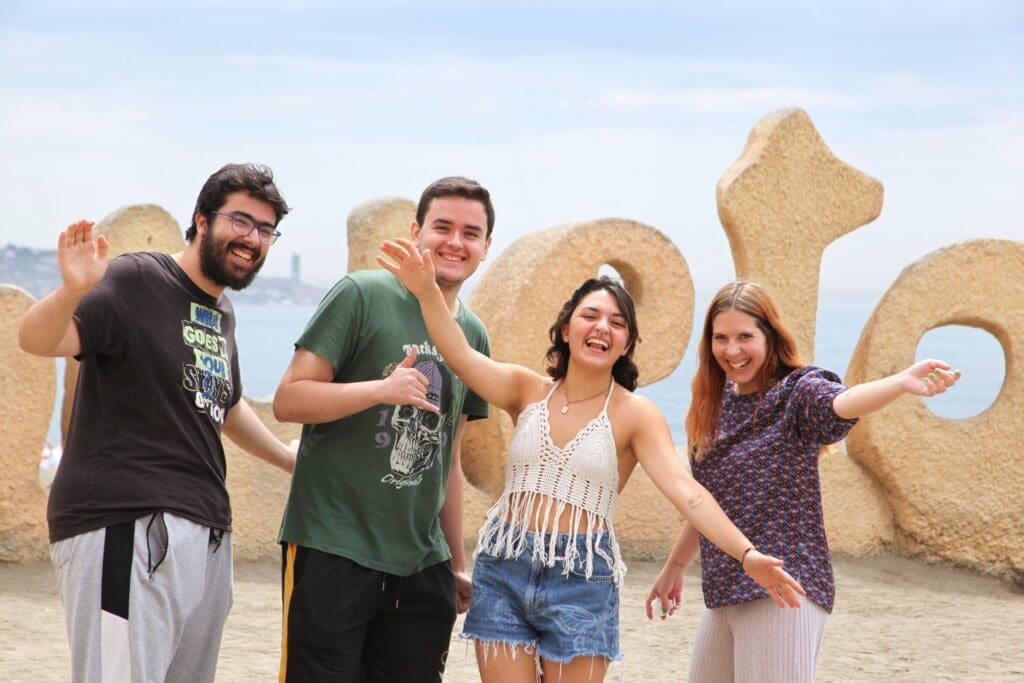
The school also runs a free weekly programme (a cultural workshop, an old town tour, a flamenco class, tapas on Friday at your own cost, and a small-fee tuk-tuk ride), and for Erasmus students this is where you stop meeting only people from your own degree and start meeting other international students in your first days, rather than during the chaos of enrolment week. Ask at reception for the current week’s programme.
What if your appointment lands after day 14?
It happens, and it is not a sign you did something wrong. Appointment availability for the NIE, the TIE and empadronamiento in Málaga depends on demand that has nothing to do with your file, and in a busy intake month, a slot booked in week one can still fall in week three or four. What protects you is requesting every appointment in week one: by the time it arrives, your Spanish has already improved enough that the appointment itself goes faster, and you are not also racing a deadline you did not plan around.
If a deadline from your home university or a bank genuinely cannot wait, that is what VAMOS Spain Legal Services is for: a registered lawyer in Málaga manages the appointment and the file for you, for a fixed fee (NIE or TIE from €150, empadronamiento from €80, plus VAT; government fees separate). Not every Erasmus student needs it, but it is worth knowing it exists before week three becomes a problem.
Which Spanish course actually fits these first two weeks?
Before term, two to four weeks of our Intensive course, 20 hours a week, Monday to Friday 9:30 to 13:30, are enough to start your semester already speaking: €200 for 1 week, €400 for 2, €740 for 4. If you want more one-to-one time in those same two weeks, Super Intensive adds 5 one-to-one hours a week in the afternoon, at times you agree with your teacher, for €299 a week against €200 for Intensive; those hours do not move you through the course plan faster, they let a teacher work only on what you choose, which for the next 14 days is probably the vocabulary of forms, addresses and appointments rather than textbook Spanish.
| Course | Hours a week | Price (short stay) | Best for |
|---|---|---|---|
| Intensive | 20 (group) | €200/week | Most Erasmus students in their first weeks |
| Super Intensive | 20 group + 5 private | €299/week | Students who want help with specific situations, like appointments and forms |
| Semi-intensive | 10 | €140/week | During term, around your lectures |
Not sure where you would start? The free Málaga level test takes about six minutes, and our academic director confirms it on your first Monday with a short written test and interview.
Frequently asked questions
Do I need a NIE if I am an EU Erasmus student in Málaga?
Yes, if you are staying more than three months, which almost every semester or full-year exchange does. You register as an EU citizen using form EX18 and receive a certificate with your NIE number once approved, as set out on the Policía Nacional’s own page for the Certificate of Registration of EU Citizens.
I am a non-EU student. Do I need a NIE or a TIE?
A TIE. Your long-stay student visa already lets you enter and stay; the TIE is the physical card you apply for after arrival to prove your residence status. Our student visa and TIE guides cover the exact forms and the appointment process.
What is empadronamiento, and is it really separate from my NIE or TIE?
Yes, completely separate. Empadronamiento registers your address with Málaga’s town hall, managed by Gestrisam rather than the national police, and you need it later for things like opening a bank account or registering with a doctor. Book it in week one alongside your NIE or TIE appointment, not after it.
How do I get a Málaga transport card as an Erasmus student?
Apply online for the EMT student card if you are under 26, pay the card emission fee by credit card, then collect it in person at the EMT customer service centre in central Málaga, usually a few working days after you apply. If you are enrolled at the University of Málaga, your UMA student card can be activated at the EMT office instead of applying online.
Can I get a Spanish SIM card without an appointment?
Yes. A Spanish SIM is the one item on this list with no appointment at all: any phone shop or supermarket phone counter near the centre sells prepaid SIMs, usually with your passport as the only document needed.
What if my appointment does not come through before my course or term starts?
That is common and not something you can always control, since appointment availability depends on demand rather than your own file. Request every appointment in your first days regardless, keep your confirmation and any reference number, and consider a fixed-fee legal service if a hard deadline from your university or bank cannot wait.
Should I start Spanish classes before or after sorting the paperwork?
Before, or alongside it. Four hours of Spanish a day in your first week means you understand the forms and the questions an official asks you, rather than guessing. New Intensive groups start every Monday the school is open, so you do not need to wait for your paperwork to be finished first.
Can VAMOS Spain Legal Services do all of this for me?
It can handle the NIE or TIE file (from €150) and the empadronamiento (from €80, plus VAT, government fees separate), with a registered lawyer in Málaga managing the appointment and the paperwork. It does not replace the transport card or SIM steps, which you can do yourself in a single visit with no appointment needed for the SIM.
Ready to start your first 14 days already speaking some Spanish?
Book your Intensive weeks, take the free level test to see where you start, and send us your arrival date on WhatsApp if you want a programme to match it.
Related reading - Erasmus in Málaga in February 2027: your 2 to 4 week Spanish plan - What Level of Spanish Do You Need for Erasmus in Málaga? - Cost of Living in Málaga for Students
Sources: our own pages, checked 28 October 2026: Spanish courses for Erasmus students in Málaga, Málaga prices, Intensive course, student visa guide, NIE in Málaga guide, TIE card guide, empadronamiento guide, VAMOS Spain Legal Services. Official sources, checked 28 October 2026: Policía Nacional, Certificate of Registration of EU Citizens (NIE); Punto de Acceso General (administracion.gob.es), registering your residence as an EU citizen; Ayuntamiento de Málaga / Gestrisam, appointment for the padrón municipal (empadronamiento); EMT Málaga, student transport card.
Updated 28 October 2026.