

OUR INTENSIVE GROUP SPANISH CLASSES IN MALAGA

We offer group IN-PERSON classes for all Spanish skill levels.
Learn how to read, write, speak and understand Spanish. Whether you are starting from scratch or seeking to enhance your proficiency, our tailor made curriculum will assist you in achieving your language learning objectives!

Average of 3 to 5 students per class from A1 to C2 (All levels according to the European Framework of Reference for Languages)

New classes start every Monday for all skill levels

monday-friday 9:30am-1:30pm

Course structure: 20 lessons per week, each lasting 50 minutes

Duration: Starts every Monday. Lasts between 1 and 32 weeks.

STARTING AT €200/week, all inclusive, with no registration fees

includes all class materials-you only need to bring a pen & notebook

discounts for multi-week reservations
Study plan · Spanish in Málaga
Intensive group course
Twenty hours of class a week (4 hours of class a day with a 30-minute break, Monday to Friday) in groups of no more than 5 students. It is the fastest, most complete way to immerse yourself and move from A1 to C2, following a structured plan aligned with the CEFR and the Instituto Cervantes Curricular Plan.
From A1 to C2: 20 h of class/wk 32 weeks · 8 months 640 h of class 980 h total study CEFR · PCIC
The intensive method
Maximum exposure to the language in the shortest possible time, without ever sacrificing personal attention.
Immersion
Twenty hours a week
4 hours of class a day with a 30-minute break, Monday to Friday in the morning. You progress quickly because you practise every single day.
Small groups
No more than 5 students
Small classes that guarantee plenty of speaking time, careful correction and close, personal attention for everyone.
A1 → C2
The complete journey
A structured level-by-level itinerary, with clear objectives, units and descriptors aligned with the CEFR.
Academic progression
Each level is completed in intensive mode and is split into sections: at A1 and A2 each section lasts one week, and from B1 onwards each section lasts two weeks. The full A1 to C2 journey adds up to 640 hours of class plus 340 hours of independent study, 980 hours in total, over 32 weeks (8 months).
| Level (CEFR) | Class hours | Self-study | Total | Sections | Estimated duration |
|---|---|---|---|---|---|
| A1 | 80 h | 40 h | 120 h | 4 × 1 wk | 4 weeks · 1 month |
| A2 | 80 h | 40 h | 120 h | 4 × 1 wk | 4 weeks · 1 month |
| B1 | 120 h | 60 h | 180 h | 3 × 2 wks | 6 weeks · 1.5 months |
| B2 | 120 h | 60 h | 180 h | 3 × 2 wks | 6 weeks · 1.5 months |
| C1 | 120 h | 60 h | 180 h | 3 × 2 wks | 6 weeks · 1.5 months |
| C2 | 120 h | 80 h | 200 h | 3 × 2 wks | 6 weeks · 1.5 months |
| Total | 640 h | 340 h | 980 h | 20 sections | 32 weeks · 8 months |
Objectives and content by level
Each level sets out clear objectives, thematic units and the CEFR "can-do" descriptors. Choose a level to see the detail.
"You find your way in simple everyday situations: you introduce yourself, describe your family and your city, and talk about your routines, tastes and plans."
Objectives
- Introduce yourself and describe your family, home and city
- Express routines, preferences and plans
- Go shopping, order in a restaurant and ask for directions
- Understand very simple texts and write short phrases
Units
- 1. Who am I? Greetings, personal details, ser/estar/tener
- 2. When? Shopping, restaurant, comparatives, ir a + infinitive
- 3. What do you like? Routines, gustar, directions
- 4. What are you doing? Present continuous, recent past
"You communicate in simple day-to-day exchanges, recount past experiences and describe your surroundings in greater detail."
Objectives
- Talk simply about your life, studies and work
- Narrate personal experiences and anecdotes
- Express intentions and causes
- Understand short, clear messages; write basic notes and letters
Units
- 1. My biography: past tenses and causes
- 2. Connecting with the past: the imperfect and habits
- 3. What happened to you? Contrast of past tenses, accidents
- 4. I had never seen anything like this! The pluperfect and narrative connectors
"You handle a wide range of situations with confidence: you narrate in the past and express opinions, wishes and conditions."
Objectives
- Tell stories and express hypotheses
- Grasp the main idea of clear spoken and written texts
- Take part in everyday conversations; follow radio and TV at a clear pace
- Write simple, coherent texts and personal letters
Units
- 1. I told you so! Reported speech and emphasis
- 2. What will be, will be: the future, conditionals 1-2, doubt
- 3. Listen to me! The imperative, orders, instructions and advice
"You communicate fluently and spontaneously across a wide range of contexts, defend your point of view and take part in debates."
Objectives
- Understand extended speech and complex texts
- Produce clear, well-structured contributions; defend a point of view
- Understand articles and reports; write essays and argumentative texts
- Express nuanced opinions, emotions, hypotheses and conditionals
Units
- 1. What do you recommend? Advising and suggesting, the subjunctive, wishes and need
- 2. I don't think it's easy: emotions, opinions and doubt with the subjunctive
- 3. If you lived here... Hypotheticals, compound conditional with imperfect subjunctive (imperfecto de subjuntivo)
"You express yourself with ease in social, academic and professional settings, with well-structured discourse on complex subjects."
Objectives
- Produce well-structured spoken and written discourse on complex topics
- Understand long speeches, even when they are not clearly structured
- Follow films, lectures and debates across different varieties of Spanish
- Analyse and interpret complex texts; write essays, articles and reports
Units
- 1. Connectors and advanced structures: relative pronouns and verbs of change
- 2. The subjunctive and tense correlation: the compound subjunctive and concessive clauses
- 3. Complex discourse and argumentation: advanced reported speech and hypotheses about the past
"You express yourself with complete fluency and precision in any context, conveying subtle shades of meaning like an educated native speaker."
Objectives
- Understand highly complex discourse, including literary and specialised texts
- Produce clear, coherent and stylistically appropriate contributions
- Take part effortlessly in any conversation or debate
- Write high-quality essays, articles and reports
Units
- 1. Advanced language resources: impersonality, passive and reflexive constructions, verbal periphrases (perífrasis)
- 2. Cultural and linguistic nuances: idiomatic expressions and register adaptation
- 3. Academic and professional writing: argumentative texts, reports, reviews and summaries
Methodology
A communicative, task-based approach that brings together the five skills and takes Spanish into real-life situations.
Communicative approach
Spanish is used from day one in real, meaningful contexts, bringing together all five skills.
Task-based learning
Every unit is built around real tasks and situations that consolidate grammar and vocabulary.
Digital resources and independent work
Authentic materials, digital platforms and independent study so that learning carries on beyond the classroom.
Assessment
A thorough, transparent process that accompanies you from the very start to the completion of each level.
Initial diagnostic
A placement test sets you at the right CEFR level before you begin.
Ongoing formative
Regular tests, class participation and assignments, with constant feedback.
Final summative
Each level closes with an integrated assessment of all five competences, marked against standardised rubrics.
Certification
Internal certificate aligned with the CEFR
At the end of each level you receive a certificate of attendance and achievement that reflects your progress against the CEFR descriptors and documents the hours you have completed.
Preparation for official exams
The course can be combined with focused preparation for the internationally recognised Instituto Cervantes exams.
Shall we begin?
We give you a free placement test and tell you exactly which level and which week you'll join. You arrive able to order a coffee; you leave debating on a sunny terrace.
Ask about the intensive group course in Málaga
Tell us your level and the dates you have in mind, our Málaga team replies within one business day.
How the Course Works?
The Intensive Spanish Course at Academia Vamos is divided into Sections, each with 20 hours of classroom time and 10 hours of independent work. Altogether, these Sections add up to the total hours of each CEFR level, ensuring steady progress. At the A1 and A2 levels, the course is organized into 4 Sections of 1 week each (120 hours in total). At the higher levels (B1-C2), the course is structured in 3 Sections, but each Section lasts 2 weeks, keeping the same total hours while adapting to the greater complexity of learning. This modular design helps students progress step by step and develop their language skills clearly and effectively.
What are the contents of the course?
How is the Intensive Spanish Course organized?
How many hours do I need to complete a level?
What is “independent work?
Can I move to the next level without finishing all Sections?
What is the difference between basic, intermediate, and advanced levels?
How do I know I’m progressing?
Why is this modular system useful?


INTENSIVE GROUP SPANISH CLASSES IN MÁLAGA, 20 LESSONS PER WEEK
-
At Vamos Academy Málaga, we offer an intensive group program of 20 lessons per week (4 dynamic classes per day, Monday to Friday), ideal for progressing quickly and gaining real fluency in Spanish.
Each day you participate in focused sessions that improve your speaking, listening, reading, and writing skills in a balanced way, giving you practical tools to communicate naturally in real-life situations.
- Small groups (3-5 students) for personalized attention and constant interaction.
- Professional native teachers experienced in teaching Spanish, in a participatory and motivating environment.
- Specialized teaching materials designed by experts (no extra registration or book fees).
- Communicative and social approach: discussions, role-plays, everyday scenarios, and collaborative projects so you start practicing from day one.
Learn Spanish effectively while enjoying full cultural immersion in Málaga!
From 200 €/week (185 €/week if you book 4 or more consecutive weeks). Diploma included.
Want to join? Take your free level test and reserve your spot today.
Enhancing Cultural Exchange and Spanish Group Language Learning
At Vamos Academy in Malaga, we believe that social activities play a vital role in language learning and cultural immersion. Our carefully curated social events provide students with opportunities to practice their Spanish skills, connect with fellow learners, and gain a deeper understanding of the local culture.
- Join our guided walking tour of Malaga's historic center to see landmarks such as the Cathedral, Alcazaba, and Roman Theatre.
- Take part in our weekly language exchange event at a local café to practice your Spanish and meet locals.
- Attend a flamenco show at a traditional tablao to experience the passion and rhythm of Andalusian music and dance.
- Join our cooking workshop to learn how to make a classic Spanish dish such as tortilla española or gazpacho.
- Explore Malaga's beaches and parks with our bike tour that includes stops at popular viewpoints and attractions.
- Attend our cultural workshop to learn about the history and customs of the region, from Moorish architecture to local festivals and traditions.
- Join our tapas crawl and taste a variety of traditional Spanish dishes, from fried fish to Iberian ham and cheese.
- Attend our salsa dance class to learn basic steps and moves while having fun and meeting other students.
WHY GROUP SPANISH CLASSES IN MALAGA
If you're looking for a fun, engaging, and interactive way to learn Spanish, group Spanish classes in Malaga are the perfect choice. This beautiful coastal city in Andalusia, Spain, offers a fantastic setting for language learning, cultural exploration, and making new friends. Here are the top reasons why you should take group Spanish classes in Malaga:
- Small groups: Enhanced learning experience with better focus and interaction.
- Personalized attention: Tailored lessons catering to individual needs and goals.
- Qualified teachers: Highly experienced instructors passionate about teaching Spanish.
- Dynamic curriculum: Engaging materials and activities to improve all language aspects.
- Progress tracking: Regular assessments to measure and celebrate achievements.
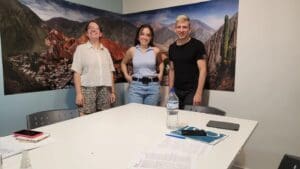
meet our teachers in Malaga
Welcome to Vamos Academy Malaga, your gateway to an extraordinary, transformative language adventure. We have an engaging video of one of our expert teachers explaining the nuances of Spanish pronunciation, a perfect example of our immersive and interactive teaching methods.
Our dedicated team of skilled educators crafts personalized learning experiences tailored to your unique goals and abilities. In our group Spanish classes, we place a strong emphasis on interactive learning within a supportive community. Alongside classroom instruction, we deepen your connection to the rich Andalusian culture through an array of social and cultural activities.
If you're considering enrolling, don't hesitate to reach out. We are more than happy to provide you with more information, share our comprehensive pronunciation video, or narrate the incredible experiences of our past students. Discover the enriching, unforgettable language journey that awaits you at Vamos Academy Malaga.