




Quick answer
A student week in Buenos Aires balances three or four hours of class with an intercambio or a barrio walk after class, a feria and one asado or day trip on the weekend, and one slow day to rest. It works because it repeats a routine instead of chasing a tourist checklist.
A student’s week in Buenos Aires is not a checklist of tourist attractions. It is class in the morning or afternoon, an intercambio or a walk through a new barrio after class, an asado or a feria on the weekend, and one day trip if you have the time. This guide covers what that week actually looks like, not what a guidebook says you should see.
In this article
What does a typical week look like for a Spanish student in Buenos Aires?
Most students take class for three or four hours a day, either in the morning or the afternoon, which leaves a full half of the day free. The rhythm that works best is not trying to fill every free hour with sightseeing. It is picking one or two things a day, doing homework or self study for thirty minutes, and treating the rest of the time as ordinary life in the city rather than a vacation.
Here is a realistic shape for a first week, adjusted to whichever half of the day your classes fall in.
| Day | After class | Evening |
|---|---|---|
| Monday | Coffee and homework at a café near school | Rest or a quiet asado at home |
| Tuesday | Walk a new barrio, Palermo or San Telmo | Intercambio or language exchange |
| Wednesday | Gym, park, or errands | Cook or eat with your homestay family |
| Thursday | Museum or bookshop | Tango class or a milonga |
| Friday | Light homework, pack for the weekend | Dinner with classmates |
| Saturday | Feria, Palermo Soho, or a day trip | Whatever the day left you energy for |
| Sunday | Laundry, self study, slow morning | Family lunch or an early night |
Weeks two and three tend to look thinner on this table and fuller in real life, once you have a routine and stop needing to plan every afternoon.
What can you do after class on weekdays?
The afternoons or mornings you are not in class are where most of the Spanish practice actually happens, more than in class itself. A few things fill that time well without turning into another obligation.
- Walk a barrio with no agenda. Palermo, San Telmo, Recoleta, and Villa Crespo each reward an aimless hour more than a rushed checklist visit. Our guide to Palermo Soho is a good starting point if you want a barrio with cafés, shops, and street art in one stretch.
- Go to a language exchange. Buenos Aires runs several weekly intercambios where you trade English for Spanish over a drink, and we cover where to find them in our guide to practicing Spanish outside the classroom.
- Sit in a café and do nothing productive. Porteño café culture is slow on purpose, and reading a menu, ordering, and chatting with the mesero is real practice.
- Take a class that is not Spanish. A tango class, a cooking class, or a running group puts you in a room full of Spanish speakers who are focused on something other than teaching you the language, which changes how you use it.
- Go to the gym or a park. The Bosques de Palermo are large enough for a proper walk or run and free to use.
How should you spend your weekends?
Weekends are where the tourist instinct is strongest, and where it is most worth resisting. One well chosen thing on Saturday and one on Sunday beats a packed two day itinerary that leaves you exhausted for Monday’s class.
FREE RESOURCES
Free Spanish study pack
Printable study sheets from our teachers, plus one short email a week.
One email, then a short weekly tip. Unsubscribe any time.

Reading about Buenos Aires from far away?
Our school is in the middle of it: small-group Spanish classes with local teachers who send you to the places tourists never find.
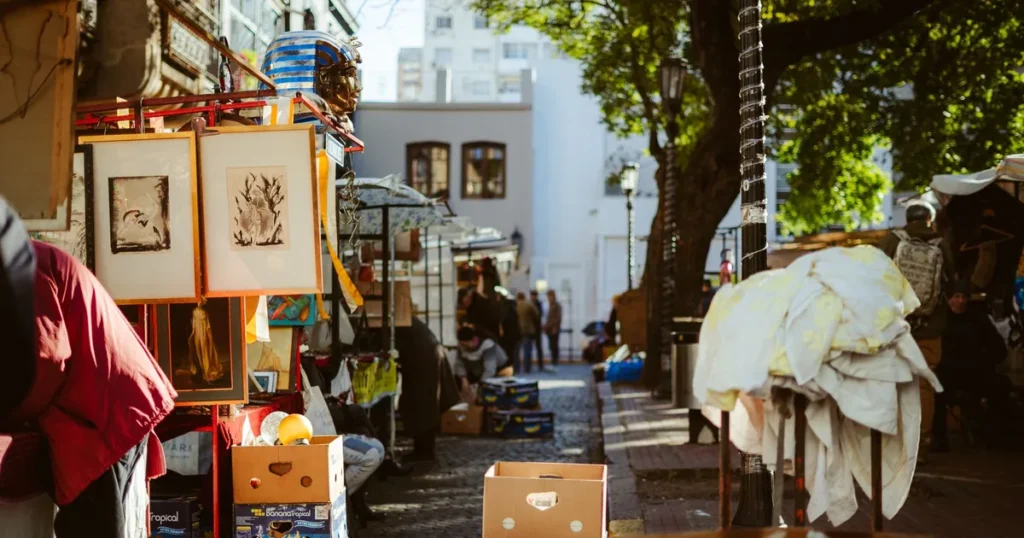
See our Buenos Aires schoolSaturday mornings are for ferias. San Telmo’s Sunday fair is the famous one, but the Saturday feria in Plaza Serrano and the smaller weekend markets in Chacarita and Belgrano are quieter and less aimed at tourists. Saturday afternoons work well for a longer barrio walk, since shops and galleries are open and the streets are busier than on a weekday.
If you have a full weekend day free, a single trip outside the city is worth it once during your stay, most commonly to Tigre for the delta or to an estancia in the countryside for an asado and horses. Do not try to combine a day trip with a full evening out afterward. Traveling and being social both use energy, and Monday’s class is easier after a quiet Saturday night than a loud one.
Sundays work best kept slow. Laundry, a bit of homework, a long lunch if you are in a homestay, and maybe a milonga in the evening if you have the energy. Our guide to homestays in Argentina covers what a typical Sunday looks like if you are living with a local family rather than in a flat.
What fits a student budget without feeling like you are missing out?
Buenos Aires is one of the more affordable cities for someone earning outside Argentina, and several of the best things to do in a student week cost little or nothing.
- Free museum days. Several major museums, including MALBA and the Museo Nacional de Bellas Artes, have free entry on specific days or times each week.
- Parks and plazas. The Japanese Garden has a small entry fee, but the Bosques de Palermo, Plaza San Martín, and most neighborhood plazas cost nothing.
- Ferias. Browsing is free, and the food stalls at most markets sell a full lunch for a modest amount.
- Free walking tours. Several operators run tip based walking tours of the center and San Telmo that are a good way to learn the layout of the city in your first week.
- Milongas with a class included. Some tango venues bundle a beginner lesson with entry, which is often cheaper than a standalone class.
Expect an evening out, dinner included, to run somewhere in the range of ten to twenty five dollars depending on where you go and how much you drink, and treat any specific number as a starting point to check once you arrive, since prices in Argentina move quickly. Our guide to the cost of living in Buenos Aires breaks down a full monthly budget by category rather than a single figure.
How do you avoid turning your week into nonstop sightseeing?
The instinct on a short trip is to see everything, and it works against you when the trip is actually a study period. Three habits keep a student week sustainable rather than exhausting.
Pick a neighborhood, not a landmark list. Getting to know one or two barrios well, where to get coffee, which bakery, which corner store, teaches you more about how the city actually runs than visiting every recommended sight once.
Protect one slow day a week. A day with no plans, where you do laundry, catch up on homework, and go to bed early, is what makes the following week possible. Students who skip this tend to burn out by week three.
Let repetition do the work. Going to the same café, the same feria stall, or the same intercambio every week builds the kind of familiarity and small talk that a new location every night never does. If you are staying long enough that this matters for your paperwork, our guide to the student visa for Argentina covers when you actually need one.
If you are still in the planning stage before you arrive, our guide to preparing for a study abroad trip covers what to sort out before you land, so your first week in Buenos Aires can look more like the one above and less like jet lagged improvisation.
Our Spanish courses in Buenos Aires are built around a similar idea: enough class to make real progress, a schedule that leaves your afternoons free, and a team that can point you toward the intercambio, the feria, or the asado that fits the week you are actually having.
Frequently asked questions
How many hours a week should I spend outside class practicing Spanish?
There is no fixed number, but students who spend even a few hours a week in Spanish outside class, at a feria, an intercambio, or a homestay dinner table, tend to progress noticeably faster than those who only attend lessons.
Is Buenos Aires safe for students exploring after class?
Central barrios popular with students, including Palermo, Recoleta, and much of San Telmo, are generally safe to walk during the day and in the early evening. Use the same common sense you would in any large city at night: stick to busier streets, keep your phone out of sight, and take a taxi or app based ride rather than walking long distances late.
What if I only have two or three weeks in Buenos Aires?
Skip the day trip and put the time into one or two barrios instead. A short stay benefits more from a routine you can repeat, café, class, walk, intercambio, than from trying to see the whole city once.
Should I plan a day trip outside the city while I am studying?
One is worth it, usually to Tigre or an estancia, but treat it as a single weekend event rather than something you repeat. Most of the language and cultural benefit of a study trip comes from routine inside the city, not from time spent traveling to see something new.