



Quick answer
Spain has no official lyrics to its national anthem, one of only a few countries in that position. It sits on Central European Time despite aligning geographically with Britain, which is why lunch is at two and dinner at ten. Spanish is not the only official language: Catalan, Galician and Basque are co-official, and Basque is unrelated to any other known language.
Spain is stranger than the tourist version suggests. Some of what follows is well known and wrong, some is barely known and true, and a few things are simply peculiar. We teach in Málaga, so several of these are from the doorstep.
In this article
What is Spain famous for?
Flamenco, tapas, football, siestas and beaches, most of which are half true. Flamenco is Andalusian rather than national. Tapas culture varies enormously by region. The siesta is largely gone from working life while its cause, the meal timings, remains. And Spain has more coastline than most visitors ever see, most of it not the Costa del Sol.
What are some interesting facts about Spain?
- Spain has no official national anthem lyrics. The Marcha Real is one of only a handful of national anthems in the world with no words. Attempts to add some have repeatedly failed.
- It is the second most visited country on earth, behind France, with a population under fifty million.
- Spanish is not the only official language. Catalan, Galician and Basque hold co-official status in their regions. Basque is unrelated to any other known language on earth.
- Lunch is at two and dinner at ten. Spain sits on Central European Time despite being geographically aligned with Britain, a decision taken in 1940, so the clock runs roughly an hour ahead of the sun.
- Spain has the oldest restaurant in the world. Botín in Madrid, operating since 1725 and holding the Guinness record.
- There are more bars per person than in almost any other country, on the order of one for every couple of hundred people.
What is unusual about Andalusia?
Andalusia is the part of Spain most people picture when they picture Spain, and it is also the least typical.
Want to experience this in person?
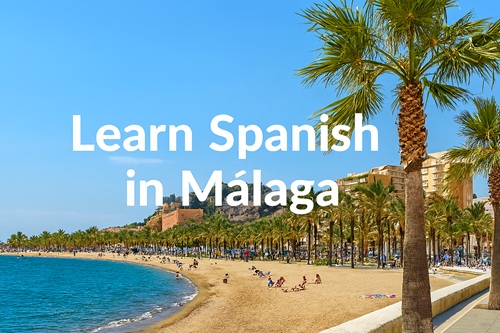
Small-group Spanish courses a short walk from Málaga’s old town, with teachers who live here.
Visit our school in Málaga- Eight centuries of Islamic rule left the Alhambra in Granada, the Mezquita in Córdoba and the architecture of half the region. Al-Andalus lasted from 711 until 1492.
- The accent drops sounds. Final s disappears, d between vowels vanishes, and the result is fast, musical and initially bewildering. Buenas tardes becomes something closer to buena tarde.
- Flamenco is from here, specifically from the Roma communities of Andalusia, and it was recognised by UNESCO as Intangible Cultural Heritage.
- Europe’s only desert is in Almería, which is why dozens of spaghetti westerns were filmed there.
- Málaga has more hours of sunshine than almost anywhere else in Europe, around three hundred days a year.
What do Spaniards do differently?
- Two surnames. Everyone carries their father’s first surname and their mother’s first surname, and women do not change their names on marriage.
- New Year is eaten, not drunk. Twelve grapes, one on each chime of midnight, and choking slightly is part of it.
- Christmas presents can arrive on 6 January, brought by the Three Kings rather than Father Christmas.
- Dinner guests arrive late deliberately. Turning up exactly on time is mildly awkward.
- The cheek kiss is two, starting on the right. In Argentina it is one, which produces reliable collisions.
What surprises people about the Spanish language in Spain?
Three things, and all of them catch out learners who studied Latin American Spanish:
- Vosotros exists. The informal plural you, used constantly in Spain and essentially absent across Latin America. Textbooks written for American learners often skip it entirely.
- The distinción and seseo split. In most of Spain, c before e or i and z are pronounced like the th in “think”. In Latin America and parts of Andalusia they are pronounced s.
- Coger is completely ordinary here. It means to take or catch, as in a bus. In Argentina and Mexico it is explicitly vulgar, which is why Spanish courses aimed at the Americas quietly avoid it.
What is worth seeing beyond the obvious?
- Setenil de las Bodegas, an Andalusian town built underneath an overhanging cliff, with houses whose ceilings are rock.
- Las Médulas, a landscape of red peaks in León left behind by Roman gold mining.
- The Caminito del Rey, a walkway pinned to a gorge an hour from Málaga, once considered among the most dangerous paths in the world and now safely rebuilt.
- Cabo de Gata, volcanic coastline in Almería with beaches that never made it onto a postcard.
If you would rather learn the language where these are a bus ride away, we teach in Málaga, and the free level test tells you where to start.
FREE RESOURCES
Free Spanish study pack
Printable study sheets from our teachers, plus one short email a week.
One email, then a short weekly tip. Unsubscribe any time.

Frequently asked questions
What is Spain best known for?
Flamenco, tapas, football, its beaches and its architecture, from the Alhambra to Gaudí. It is also the second most visited country in the world and holds one of the largest numbers of UNESCO World Heritage sites.
What are some weird things about Spain?
The national anthem has no lyrics, the country sits an hour out of step with its own sunlight because of a clock decision made in 1940, everyone carries two surnames, and New Year is marked by eating twelve grapes against the clock at midnight.
Do they speak only Spanish in Spain?
No. Spanish is official nationwide, and Catalan, Galician and Basque are co-official in their regions. Basque is a language isolate, unrelated to any other known language, and predates the arrival of Latin in Iberia.
Why do Spaniards eat so late?
Partly habit and partly the clock. Spain adopted Central European Time in 1940 despite sitting on the same longitude as Britain, so solar noon falls around two in the afternoon. Lunch at two and dinner at ten are closer to the sun than they look.
Test yourself
Quick quiz
Quick quiz: facts about Spain
0 of 5 answered