
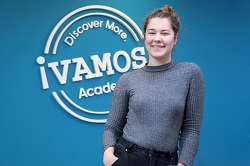



By Raquel Cobos, School Manager, Vamos Academy (Málaga & Buenos Aires)
Spain and Latin America share one language but speak it in noticeably different ways: the accent, some grammar (vosotros vs. ustedes, tú vs. vos), and hundreds of everyday words change from one side of the Atlantic to the other. Neither version is “more correct” Spanish, the Real Academia Española and the Instituto Cervantes treat every regional variety as equally valid, including on the DELE exam. Which one you should learn simply depends on where you’ll use it: European travel, EU paperwork, and exam prep point toward Spain’s Spanish, while a Latin American trip, career, or family tie points the other way.
At Vamos Academy we’re not comparing these two Spanish varieties from a textbook. We run two real campuses: one in Málaga, on Spain’s Costa del Sol, and one in Buenos Aires, Argentina, and our own teachers speak with the accents students are asking about. This guide breaks down the actual differences, city by city, so you can pick the version that matches your goals.
In this article
What Are the Real Differences Between Spain and Latin American Spanish?
The differences fall into three buckets: pronunciation, grammar, and vocabulary. None of them are large enough to stop a Spaniard and an Argentine from understanding each other, think of the gap between British and American English, but they’re large enough to notice within the first few sentences of a conversation.
It’s also worth saying upfront that “Latin American Spanish” isn’t one accent either. Mexican, Colombian, Chilean, and Argentine Spanish differ from each other almost as much as they differ from Spain’s. When people say “Latin American Spanish” they usually mean a rough, shared core, ustedes instead of vosotros, seseo pronunciation, and a common vocabulary, layered under very distinct national accents.
How Different Is the Pronunciation, and Why Doesn’t Málaga Sound Like a Madrid Newsreader?
This is the difference most people ask about first, and it’s also where competitor guides tend to oversimplify. Here’s the more accurate picture:
- Central and northern Spain (distinción): Words with “c” (before e/i) or “z” cielo, zapato are pronounced with a soft “th” sound, distinct from “s”. This is the accent most people picture when they say “Spain Spanish.”
- Málaga and much of Andalusia (seseo): Here’s the part most articles skip, Málaga doesn’t use that “th” distinction. The city speaks with seseo, pronouncing “c/z” the same as “s,” just like Latin America (other pockets of Andalusia go the opposite way, with ceceo), plus a fast, softened rhythm that often drops the final “s” or “d” in words. If you study in Málaga, you won’t come out sounding like a Castilian newsreader, you’ll pick up a warmer, more relaxed southern accent.
- Latin America (seseo, plus huge regional variety): Seseo is universal across Latin America, but the accents on top of it vary enormously: the clipped clarity often associated with Mexican Spanish, the Caribbean tendency to soften or drop consonants, and Argentina’s unmistakable “sh” sound for “ll” and “y” (yo becomes something closer to “sho”).
- Buenos Aires specifically: The Rioplatense accent has a musical, almost Italian-influenced intonation, a legacy of the massive Italian immigration of the late 19th and early 20th centuries, combined with that distinctive “sh” pronunciation and a slang vocabulary called lunfardo.
Do Spain and Latin America Use Different Grammar? (Vosotros, Ustedes, and Voseo Explained)
Grammar is where the two varieties diverge most clearly, and it comes down to two things: how “you” (plural and informal) is expressed, and which past tense people reach for by default.
Vosotros vs. ustedes
In Spain, vosotros is the everyday informal “you all” used with friends, family, classmates, while ustedes is reserved for formal or very large groups. Across Latin America, vosotros has essentially disappeared from daily speech; ustedes covers both formal and informal plural “you,” with its own verb conjugation (ustedes hablan rather than vosotros habláis).
Tú vs. vos
Most of Spain and much of Latin America use tú for informal “you.” Argentina, Uruguay, and parts of Central America instead use vos, with its own conjugation pattern: vos sos (not tú eres), vos tenés (not tú tienes), vos querés (not tú quieres). Students who learn tú first can generally still understand voseo it just takes a little exposure, which is exactly what studying in Buenos Aires provides.
Which past tense do people actually use?
Spain tends to favour the present perfect (he comido “I have eaten”) for anything that happened earlier the same day, while most of Latin America defaults to the simple past (comí “I ate”) even for very recent events. Neither is wrong; it’s a matter of everyday habit that textbooks rarely flag.

What Vocabulary Words Change Between Spain and Latin America?
Vocabulary is where beginners get tripped up fastest, because the words in question are everyday ones. A short reference table:
| English | Spain | Latin America (general) |
|---|---|---|
| Car | coche | carro / auto |
| Computer | ordenador | computadora |
| Mobile phone | móvil | celular |
| Juice | zumo | jugo |
| Potato | patata | papa |
| To drive | conducir | manejar |
| To take/grab | coger | agarrar / tomar |
One word deserves a warning: coger is a completely neutral verb (“to take” or “to catch”) in Spain, but in several Latin American countries, including Argentina and Mexico, it’s vulgar slang. Students moving between the two regions usually learn to swap it for agarrar or tomar once they cross the Atlantic, and it’s one of the first things our teachers flag in class.
Which Spanish Should You Learn for the DELE or SIELE Exam?
Good news if an official qualification is your goal: the Instituto Cervantes, which sets the DELE and SIELE exams, explicitly accepts all regional varieties of Spanish as equally valid for certification. You won’t lose points for using ustedes instead of vosotros, or carro instead of coche examiners are assessing whether your grammar and vocabulary are used correctly and consistently, not which region you learned from.
That said, most DELE preparation materials and exam centres in Spain are naturally built around Peninsular Spanish, so studying in-country before the exam still has practical value, you get used to the accent you’ll hear in the listening sections. Vamos Academy runs a dedicated DELE and SIELE preparation centre in Málaga, with small-group courses from €200 per week and private classes from €30 per hour, tailored to your target level and exam date.
Is Spain or Latin American Spanish Better for Travel, Work, or Family Ties?
There’s no universally “better” option, it depends entirely on why you’re learning:
- Career and business: If your work involves the EU, Spain-based companies, or the Spanish market specifically, Peninsular Spanish and time in Spain will serve you better. If you’re aiming at Latin American trade, the US Hispanic market, or remote work with clients across the Americas, Latin American Spanish is more directly useful.
- Travel plans: Learn the accent of wherever you’re actually going. If your itinerary is Spain and Portugal, study Spain’s Spanish; if it’s Argentina, Chile, or Mexico, lean into the regional variety you’ll hear on the ground.
- Family or heritage: Many students are simply reconnecting with a grandparent’s or partner’s accent, in that case, the “right” Spanish is whichever one your family speaks.
- Cost and logistics of studying abroad: Budget matters too. If Spain is the plan, it helps to know real numbers in advance, our Málaga cost-of-living guide for students breaks down monthly housing, food, and transport costs so there are no surprises once you land.
- Longer stays in Spain: If you’re considering more than a short course, it’s worth reading up on the practical side early, our guides to the Spain student visa and the NIE number cover the paperwork you’ll eventually need.
Want to learn the Spanish that’s actually spoken on the street in Andalusia?
FREE RESOURCES
Free Spanish study pack
Printable study sheets from our teachers, plus one short email a week.
One email, then a short weekly tip. Unsubscribe any time.

TripAdvisor Travelers' Choice winner
Read the Málaga reviews
Written by Raquel CobosSchool Manager, Vamos Academy
Study in small groups averaging 3-5 students at our Málaga campus in La Malagueta, close to the beach and the old town, with experienced, certified teachers and classes mapped to CEFR levels A1 through C2.
Should You Study in Málaga or Buenos Aires?
Since Vamos Academy teaches at both ends of this comparison, it’s worth laying out what each city actually offers rather than speaking in generalities.
Málaga, Spain
Our Málaga campus sits in the La Malagueta neighbourhood, close to the beach and Málaga’s historic centre. Classes average 3-5 students and are structured around CEFR levels A1-C2. As covered above, the accent here is Andalusian, softer and seseo-based, not the “Castilian lisp” many students expect. It’s also our base for DELE/SIELE exam preparation.
Buenos Aires, Argentina
Our Buenos Aires school immerses students directly in the Rioplatense accent and voseo grammar described earlier, the fastest way to get comfortable with vos sos and vos tenés is to hear them all day, every day. Course options range from intensive and semi-intensive group programmes to private one-on-one lessons, with homestay accommodation available for students who want full immersion outside the classroom too.
Can’t relocate? Study online instead
If travel isn’t an option right now, our online Spanish classes are worth a look. Group classes draw on teachers from a range of backgrounds, so you won’t choose a specific regional accent there, but private online lessons can be matched to your accent preference as much as scheduling allows, whether that’s Spain’s Spanish or a Latin American variety. Full pricing for every format, both in-person and online, is listed on our pricing page.

Ready to start learning, wherever your Spanish takes you?
Whether you choose Málaga, Buenos Aires, or online classes, registration starts with a placement test so we can match you to the right group and accent focus.
Frequently Asked Questions
Is Latin American Spanish easier to learn than Spain’s Spanish?
Not inherently, difficulty depends more on which specific accent and grammar features you’re exposed to than on “Spain vs. Latin America” as a whole. Some learners find seseo-based accents (most of Latin America, and Andalusia in Spain) easier to parse at first than fast, consonant-dropping accents. Grammar-wise, sticking with tú instead of learning vos conjugations removes one extra pattern, but it’s a minor difference in the overall picture.
Will people in Mexico or Argentina understand Spain’s Spanish?
Yes. The differences are similar in scale to British vs. American English, accent and word choice vary, but comprehension isn’t a real barrier. The occasional vocabulary mix-up (like coger, mentioned above) is more likely to cause a laugh than genuine confusion.
Does Vamos Academy teach Spain Spanish or Latin American Spanish?
Both, depending on where you study. Our Málaga school teaches with an Andalusian accent as part of daily immersion, and our Buenos Aires school teaches with the Rioplatense accent and voseo. Online, group classes mix teacher backgrounds, while private online lessons can be matched to your preferred accent as far as possible.
Which Spanish does the DELE exam use?
None exclusively. The Instituto Cervantes accepts all regional varieties of Spanish as equally valid for the DELE and SIELE diplomas: what’s assessed is correct, consistent use of grammar and vocabulary, not which country’s accent you speak with.
Should I learn tú or vos?
Learn tú if you’re not planning to spend significant time in Argentina, Uruguay, or voseo-using parts of Central America, it’s the more widely applicable default. If Buenos Aires (or another voseo region) is your destination, it’s worth learning vos conjugations directly rather than translating from tú in your head.
Can I switch between Spain and Latin American Spanish later on?
Yes, easily. Most fluent speakers who move between regions adapt within a few weeks of immersion, swapping a handful of vocabulary words and picking up the local accent naturally. Your grammar foundation carries over regardless of which variety you started with.
Test yourself
Quick quiz
Quick quiz: Spain and Latin American Spanish
0 of 5 answered