






Quick answer
Mate is a hot infusion of dried yerba mate leaves, sipped through a metal straw called a bombilla from a gourd that is passed around and shared. One person, the cebador, prepares and serves for everyone. Saying gracias means you want no more, so do not say it until you are finished.
Mate (pronounced MAH-teh) is Argentina’s national drink: a hot infusion of dried yerba mate leaves, sipped through a metal straw called a bombilla from a gourd that is passed around and shared. It has been Argentina’s official “national infusion” by law since 2013, and Argentines drink it constantly, roughly 260 million kilos of yerba per year, about 6.5 kg per person, according to the National Yerba Mate Institute (INYM, 2025 figures). More than a beverage, mate is a social ritual: one gourd, one server, one circle of people drinking in turn.
Our teachers in Buenos Aires often share mate with students during class breaks, and for many of them it is the first cultural lesson, before the subjunctive, before anything. Here is everything you actually need to know: what mate is, how to prepare it properly, the unwritten rules nobody warns you about, and which yerba to buy first.
In this article
What Is Mate in Argentina?
Strictly speaking, three things share the name. Yerba mate is the plant, Ilex paraguariensis, a species of holly native to the subtropical forests of South America. The mate is the vessel, traditionally a hollowed, cured calabash gourd. And “un mate” is the drink itself: the gourd packed about two-thirds full with dried, ground leaves and stems, topped up with hot (never boiling) water, over and over, until the yerba loses its flavour.
What makes mate different from tea or coffee is not the recipe. It is the social code. One person, the cebador, prepares and serves. Everyone drinks from the same gourd and the same bombilla, in turn. Refusing a mate that is offered to you is not rude, but sharing one is an instant shortcut into Argentine social life, which is why we always tell students to say yes at least once. It sits alongside the other cultural dos and don’ts in Argentina as something worth learning before you land.
What Does Mate Taste Like?
Honest answer: bitter, grassy and herbal, closer to a strong green tea than to coffee, with a smoky, earthy edge that depends on the brand. Most Argentines drink it amargo (unsweetened), especially in Buenos Aires and the south; plenty of people, and most beginners, prefer it dulce, with a spoonful of sugar or honey added to each refill. Common variations you will meet:
- Mate dulce: sweetened with sugar or honey. No shame in starting here.
- Mate con yuyos: yerba mixed with herbs like mint (peperina), boldo or chamomile, very common in the interior.
- Tereré: yerba brewed with ice-cold water or juice. Paraguay’s version, hugely popular in northern Argentina in summer.
- Mate cocido: yerba brewed like tea, often from a teabag, served in a cup with milk. How most Argentine kids first meet the flavour.
Does Yerba Mate Have Caffeine, and Is It Healthy?
Yes, yerba mate has caffeine. It contains caffeine plus two related stimulants, theobromine and theophylline, and is naturally rich in polyphenol antioxidants, by several measures more than green tea. A full gourd session delivers a caffeine dose broadly comparable to a cup of coffee, spread over an hour or more of small sips, which is why mate drinkers describe the lift as steadier than coffee’s spike: alert, but not jittery. Research also points to benefits for focus, digestion and metabolism, though the fair summary is that mate is a healthy daily habit, not a miracle supplement.
How Does Mate Compare to Coffee and Green Tea?
Cup for cup, here is how mate stacks up against the two drinks people usually compare it to:
| Yerba mate | Coffee | Green tea | |
|---|---|---|---|
| Caffeine per cup (approx.) | 70-80 mg | ~95 mg (up to 200 mg for a strong brew) | 25-45 mg |
| Other stimulants | Theobromine + theophylline | L-theanine (calming) | |
| How it’s drunk | Shared gourd, many small refills over an hour+ | One cup, finished in minutes | One cup, individual |
| The lift | Gradual and steady, alert without jitters | Fast spike, faster dip | Mild and gentle |
| Water temperature | 70-80°C, never boiling | 90-96°C | 70-80°C |
One practical tip backed by the temperature science: let the water sit at 70-80°C not just for flavour, drinking any beverage scalding hot is hard on your throat, and mate is meant to be sipped warm, all day. For a first-hand comparison of how the two habits actually feel, read our confessional on yerba mate vs coffee, by a confused gringo in Argentina.
Why Is Mate Argentina’s National Drink?
Because the law says so, and because daily life confirms it. In 2013 the Argentine Congress declared mate the country’s national infusion (Law 26.871), and since 2015 Argentina has celebrated National Mate Day every 30 November, honouring Andrés Guacurarí, the Guaraní-born caudillo who governed Misiones. Practically all of Argentina’s yerba grows in just two provinces, Misiones and Corrientes, where the red soil and subtropical humidity suit the plant.
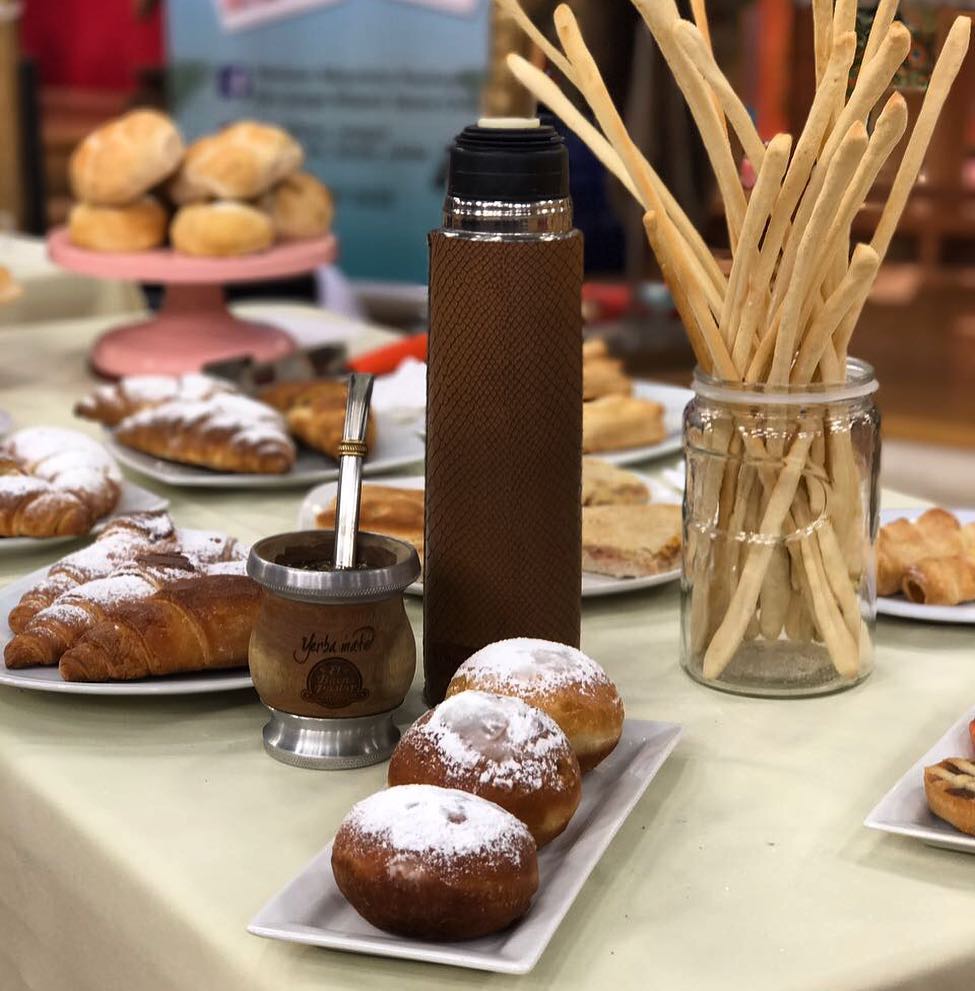
The everyday evidence is more convincing than the legislation. Walk through any Argentine park on a Sunday and you will see groups sharing a gourd around a thermos; office workers keep a mate kit at their desks; long-distance buses fill with the smell of yerba; petrol stations sell hot water at mate temperature because so many drivers travel with a thermos under one arm. There is a number behind the anecdotes, too: an INYM household survey of 5,000 homes found yerba mate present in 98% of Argentine households, across every income level. Uruguayans, for the record, drink even more mate per person than Argentines, but no country has wrapped its identity around the ritual quite like Argentina. (Fernet may be the unofficial national spirit, but mate owns the daytime.)
Where Does Yerba Mate Come From?
Mate’s history begins with the Guaraní people, who lived across present-day Paraguay, northern Argentina and southern Brazil. The Guaraní drank infusions of caá, their word for both “herb” and the plant itself, for energy, medicine and ritual, centuries before Europeans arrived. Spanish settlers adopted the habit quickly, and in the 17th century Jesuit missionaries learned to cultivate the notoriously difficult plant on their missions, turning yerba into one of colonial South America’s most valuable trade goods.
Later, mate became inseparable from the gauchos, the cowboys of the Pampas, who drank it around the fire to stay alert through long days on horseback. That line (indigenous origin, colonial trade, gaucho identity) is why mate today reads as shorthand for argentinidad: it condenses the country’s whole history into one shared gourd.
How Do You Prepare Yerba Mate, Step by Step?
Preparing mate well (cebar mate) is a skill Argentines judge kindly but notice immediately. The method:
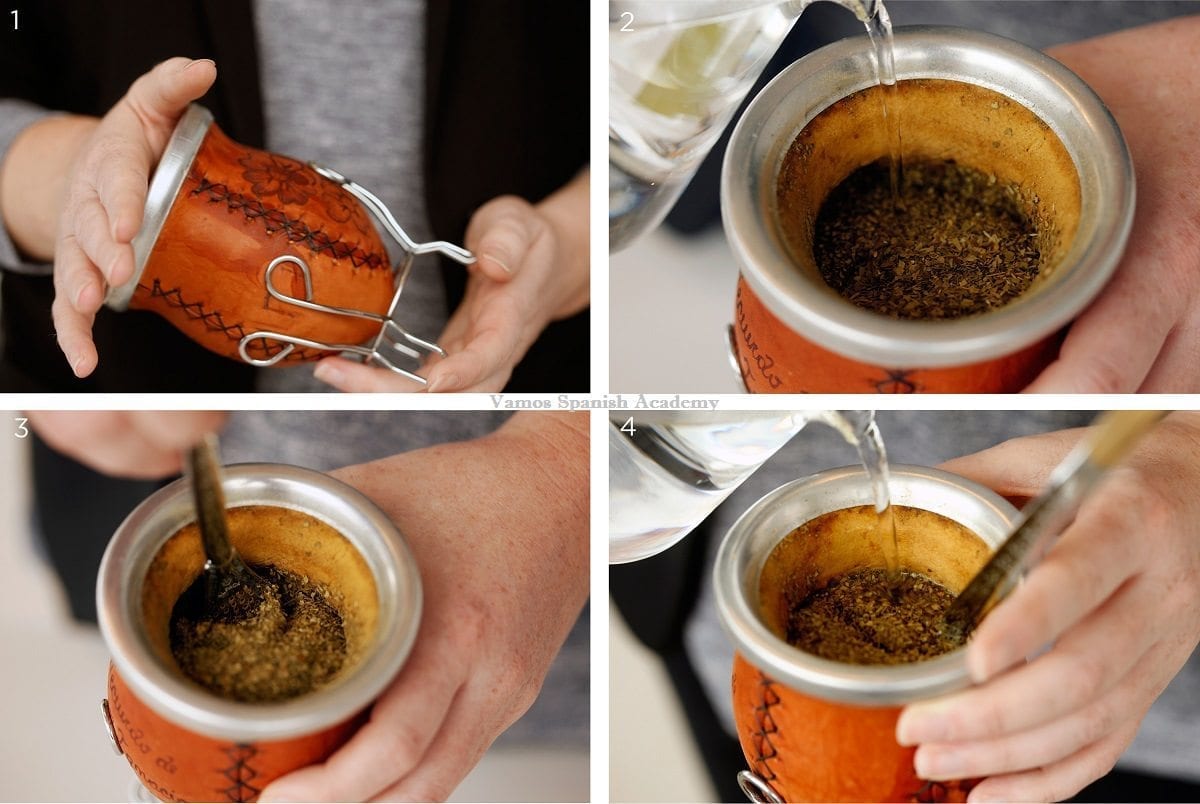
- Fill the gourd two-thirds with yerba. Not half, not to the brim: two-thirds leaves room for the water to work.
- Shake it upside down. Cover the opening with your palm, flip the gourd and shake gently. This brings the fine dust to the top of the yerba (now the bottom of your hand) so it will not clog the bombilla.
- Tilt the yerba to one side. Let the leaves settle into a slope, the montañita, leaving a hollow on the lower side.
- Moisten the hollow with cool water first. A small splash of cool or lukewarm water protects the leaves and keeps the first sips from tasting scorched.
- Insert the bombilla into the moist low side and do not move it again. The filtered end sits at the bottom of the hollow; stirring it around is the classic beginner mistake.
- Pour hot water (70-80°C, never boiling), into the hollow only. Boiling water burns the yerba and ruins the whole gourd. Wet only the low side; the dry slope is your flavour reserve for later refills. Drink, refill, pass, repeat.
The golden rule: if the kettle whistles, you have already gone too far. Argentine electric kettles literally come with a “mate” setting for this reason. When the yerba eventually loses its taste, it is lavado (washed out), time to change it.
What Are the Unwritten Rules of Drinking Mate?
Mate etiquette is real, and Argentines genuinely appreciate a foreigner who knows it. The essentials:
- The cebador drinks the first mate. The first brew is the bitterest and full of floating dust, serving it to a guest would be an insult, so the server takes the hit.
- Drink the whole gourd before passing it back. A mate is a serving, not a sip. Finish it: the gurgling slurp at the end is perfectly polite and signals you are done.
- Pass it back to the cebador, not to the next person. Only the server pours. The gourd always travels through their hands.
- Never say “gracias” unless you are finished. This is the one that catches every visitor: in the mate circle, “thank you” means “I’m done, no more for me.” Say it too early and you will be quietly skipped for the rest of the round.
- Do not touch the bombilla. Stirring with it is somewhere between bad technique and personal offence to whoever prepared the mate.
- Do not hold the mate while you talk. There is a saying: el mate no es un micrófono, “the mate is not a microphone.” Drink and pass it on.
These rules exist because mate is fundamentally about trust and equality: everyone drinks the same yerba, from the same gourd, in strict turn. It shows up everywhere from family Sundays to the office, and it pairs naturally with the late-afternoon merienda, Argentina’s beloved fourth meal.
FREE RESOURCES
Free Spanish study pack
Printable study sheets from our teachers, plus one short email a week.
One email, then a short weekly tip. Unsubscribe any time.

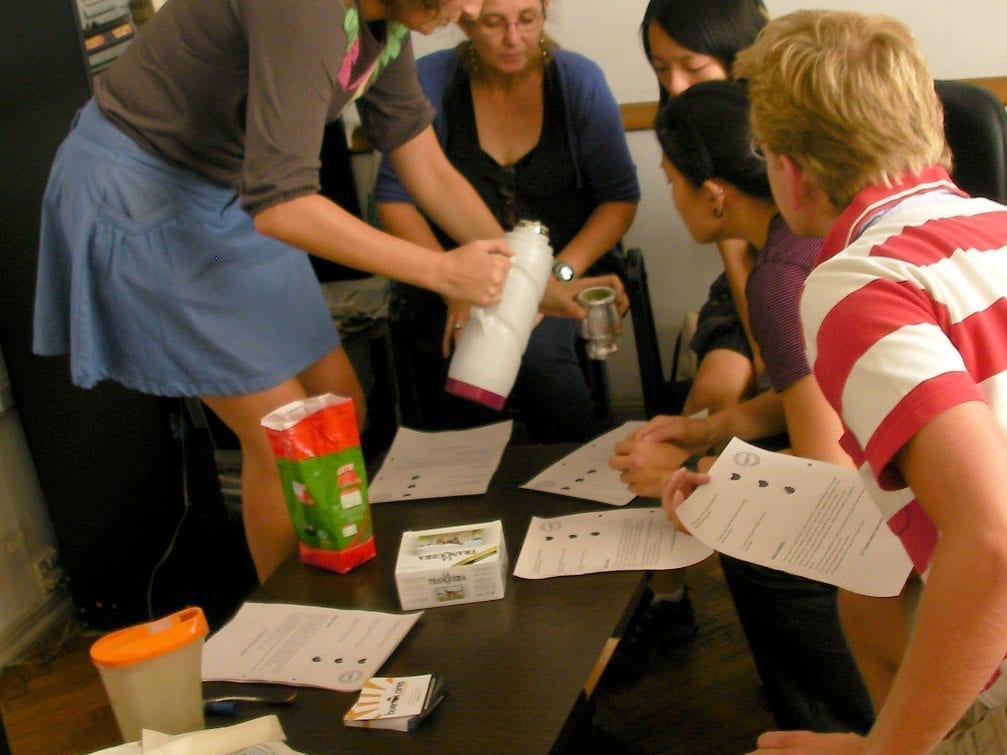
Want to learn Spanish with a mate in hand? At our Buenos Aires school, teachers often share mate with students during breaks, exactly the kind of Spanish practice no textbook can give you. Small-group courses from €200 per week.
Which Yerba Mate Brand Should You Try First?
Every supermarket aisle in Argentina has a wall of yerba. These five are the classics, and the differences between them are real:
| Brand | Flavour profile | Best for |
|---|---|---|
| Playadito | Mild, smooth, low bitterness | Beginners, the usual first recommendation |
| Cruz de Malta | Balanced, traditional | An everyday middle ground |
| Taragüi | Bold, intense, earthy | Drinkers who already like it strong |
| Rosamonte | Robust with a slightly sweet finish | Fans of a rustic, Misiones-style mate |
| La Merced | Premium; the smoked “Barbacuá” blend is the standout | A gift, or a step up once you are hooked |
As for the gourd itself: hand-carved and leather-wrapped mates are one of the best souvenirs Argentina makes. Artisans engrave calabash gourds with pampas scenes, flowers and traditional symbols, and the weekend fairs, San Telmo in Buenos Aires above all, are full of them. Remember that a natural gourd needs curing before first use; the seller will explain, and it takes a couple of days.
Where Can You Try Mate in Buenos Aires?
The local answer: mate is drunk at home, in parks and at work far more than in cafés, so the best way to try it is to get yourself invited, or to join a class at our school, where teachers often share it during breaks. That said, a growing number of cafés and specialist shops do serve it properly; we keep a separate updated list of places to try yerba mate in Buenos Aires. Better still, buy a cheap gourd, a bag of Playadito and a thermos, walk to the nearest plaza and do what everyone around you is doing.
Staying with a local family is the surest route to a standing mate invitation, as one of our students put it:
“I can also recommend highly the home stay feature of the course. I stayed with an Argentinian in the next suburb who only spoke Spanish, but who was very patient with me as I improved.”
Vamos Academy student review
Is Yerba Mate Popular in Spain?
Increasingly, yes. Spain hosts one of the world’s largest Argentine communities, and mate has travelled with it: in Madrid, Barcelona and Málaga you will now find yerba on supermarket shelves, in Latin grocery shops and herbolarios, and gourds on café terraces, often in the hands of footballers’ fans, since mate-carrying players like Messi made the habit visible across Europe. In Málaga, where our Spanish school shares a city with a sizeable Argentine population, it is entirely normal to see a thermos and gourd on the beach at sunset. Health-conscious Spaniards have adopted it too, as a gentler alternative to coffee.
For our students, that is the nice symmetry: learn the ritual in Buenos Aires or learn it in Málaga. Either way, someone will eventually hand you a gourd, and now you will know not to say “gracias” too soon.
Studying Spanish in Málaga? Our school brings a little Buenos Aires to Andalusia, with small-group courses and DELE/SIELE exam preparation. Come for the Spanish, stay for the culture.
FAQ: Quick Answers About Mate in Argentina
What is mate in Argentina?
Mate is Argentina’s national drink: a hot infusion of dried yerba mate leaves (Ilex paraguariensis) drunk through a metal straw (bombilla) from a shared gourd. It is both a daily caffeine habit and a social ritual built around sharing.
Is mate the same as yerba mate?
Almost. “Yerba mate” is the plant and the dried leaf blend you buy; “mate” is both the gourd it is drunk from and the drink itself. In Argentina, “¿unos mates?” simply means “shall we share some mate?”
Does yerba mate have caffeine?
Yes. Yerba mate contains caffeine plus theobromine and theophylline. A full shared gourd delivers a dose broadly comparable to a cup of coffee, but spread over many small sips, which is why the effect feels steadier.
Why do Argentines say “gracias” only at the end?
In the mate circle, “gracias” does not mean “thank you for this one”. It means “I’m finished, don’t serve me again.” Say it only when you genuinely want out of the rotation.
Can you drink mate every day?
Most Argentines do, often several times a day. As with coffee, moderation matters because of the caffeine, and the water should be hot (70-80°C), never scalding.
What does yerba mate taste like?
Bitter, grassy and earthy, like a much stronger green tea. Most locals drink it unsweetened (amargo), but adding sugar, honey or herbs is common and a perfectly acceptable way to start.
Is it rude to refuse mate in Argentina?
No, a simple “no, gracias” is completely acceptable, and nobody will push you. That said, accepting at least once is the fastest social shortcut Argentina offers a visitor, so unless you cannot have caffeine, say yes the first time. If you are already in the rotation and want out, say “gracias” as you hand the gourd back.
How many times can you refill mate with the same yerba?
A properly prepared gourd survives roughly 10 to 15 refills, about a half-litre to a litre of water, before the yerba goes lavado (washed out) and loses its flavour. Wetting only one side of the yerba at first is what makes it last: the dry slope is your reserve. When it finally tastes like warm water, you dump it and pack fresh yerba.
Is it sanitary to share a mate and bombilla?
Sharing one bombilla is essentially like sharing a glass, the 70-80°C water helps, but it is not sterilising, so skip the round if you are sick. Argentines know this and adapt: during the pandemic the custom shifted temporarily to “cada uno con su mate” (everyone brings their own). In normal times, sharing is precisely the point of the ritual.
Test yourself
Quick quiz
Quick quiz: mate etiquette
0 of 5 answered