






Quick answer
The nine WH question words in English are who, whom, whose, what, which, when, where, why and how. Eight of them start with the letters wh; how is the odd one out but works the same way. Each asks for a different piece of information and none of them can be answered with yes or no.
WH questions are questions built with one of nine question words (who, what, when, where, why, which, whose, whom, and how), and each one asks for a different kind of information: a person, a time, a place, a reason, a choice, or a method. Unlike Yes/No questions, a WH question can’t be answered with a simple “yes” or “no”; it demands a real answer.
Below you’ll find what each word actually asks for, a side-by-side comparison table, and answers to the exact questions people search most about who, what, when, where, why and how.
The 9 WH question words at a glance:
- Who asks about a person (the subject)
- Whom asks about a person (the object)
- Whose asks about ownership
- What asks about a thing, idea, or event
- Which asks someone to choose between options
- When asks about a time or date
- Where asks about a place
- Why asks for a reason or cause
- How asks about manner, method, or condition
In this article
What Are WH Questions?
There are two main types of questions in English: Yes/No questions (“Do you speak Spanish?”) and WH questions (“Where did you learn Spanish?”) WH questions get their name because (with one exception, how), every word in the group starts with the letters W and H: who, what, when, where, why, which, whose, and whom.
Key takeaway: There are 9 WH question words in English. Six ask about a specific category (who = person, what = thing, when = time, where = place, why = reason, how = method/manner), and three are related forms that often trip up learners: which (choice), whose (ownership), and whom (the object of a verb, the formal counterpart to who).
Language trivia: The idea of covering a story with these six questions is older than modern grammar teaching. Rudyard Kipling, who won the Nobel Prize in Literature in 1907, immortalized them in “I Keep Six Honest Serving-Men,” the poem that follows “The Elephant’s Child” in his 1902 collection Just So Stories, naming them “What and Where and When / And How and Why and Who.” Journalists still call this same list “the 5 Ws and H.”
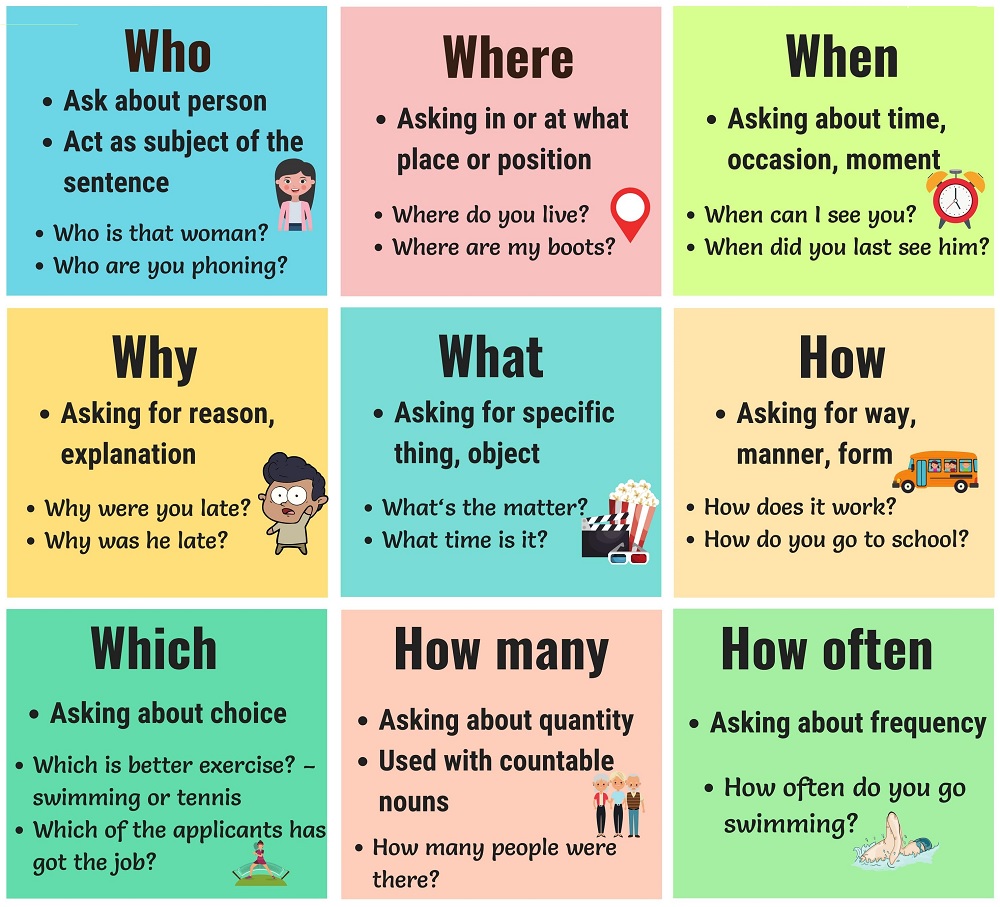
WH Question Words Compared: What Does Each One Ask?
This is the fastest way to see how who, what, which, whom, and the rest actually differ:
| Question Word | Asks About | Example Question | Typical Answer |
|---|---|---|---|
| WHO | A person (subject) | Who called you this morning? | My sister did. |
| WHAT | A thing, idea, or event | What is your favorite movie? | The Godfather. |
| WHEN | A time or date | When is the next meeting? | Next Tuesday at 10 a.m. |
| WHERE | A place or location | Where did you go on vacation? | To Buenos Aires. |
| WHY | A reason or cause | Why did you choose engineering? | Because I love solving problems. |
| WHICH | A choice between options | Which colour do you prefer? | The blue one, please. |
| WHOSE | Ownership | Whose car is parked outside? | It’s my neighbour’s. |
| WHOM | A person (object of a verb) | Whom did you see at the party? | I saw Jane. |
| HOW | Manner, method, or degree | How did you learn Spanish? | By taking live classes. |
Note: In everyday spoken English, most native speakers use who for both subject and object (“Who did you see?”), reserving whom for formal writing. You’ll rarely be corrected for skipping whom in conversation.
What Is the Difference Between Who, What, Which, and Why?
These four cause the most confusion because they can all appear in similar-looking sentences. Here’s the quickest way to tell them apart:
- Who always points to a person: “Who called you?”
- What points to a thing, action, or open-ended idea: “What happened?”
- Which points to a choice from a known, limited set: “Which of these two shirts do you like?” (You wouldn’t use what here, because the options are already on the table.)
- Why always asks for a reason and usually gets an answer starting with “because”: “Why is the receptionist so quiet today?”
Quick tip: If you can replace the question word with “for what reason,” it’s why. If you can replace it with “one of these specific options,” it’s which. If the answer could be anything at all, it’s what.
How Do You Build a WH Question? (Word Order)
Every WH question in English follows roughly the same skeleton, whether you’re asking with who, what, when, where, or how:
- Start with the WH word (Where / When / Why / What / Who / How).
- Add the auxiliary verb (do, does, did, is, are, will, can).
- Add the subject (you, she, they, the teacher).
- Finish with the main verb and the rest of the sentence.
For example: Where (WH word) + did (auxiliary) + you (subject) + buy that book? (verb + rest). The only common exception is when who or what is the subject itself, then no auxiliary is needed: “Who called you?” not “Who did call you?”
Who, When, and Where: How Do You Use Each One?
WHERE, asking about a place
Where is used to ask about a location or destination.
- Where did you buy that book?
- Where were you born?
- Where are you going this weekend?
WHEN, asking about time
When is used to ask about a time, date, or occasion.
- When will I see you again?
- When did they get married?
- When does your bus leave?
WHO, asking about the subject (a person)
Who asks about the person doing the action, the subject of the sentence.
- Who is the best teacher in the school? Sally is.
- Who will cook dinner tonight? My cousin will.
- Who won the match yesterday? The home team won.
WHOM, asking about the object (a person)
Whom also asks about a person, but as the object of the verb: the person something is done to.
- Whom did you see at the party last night? I saw Jane.
- Whom are they going to visit? Their grandparents.
Not sure which to use? Try answering with he or him. If he fits, use who. If him fits, use whom (“I saw him” → “Whom did you see?”).
Why, What, and Which: Reasons and Choices
WHY, asking for a reason
Why asks for a reason, cause, or explanation.
- Why are you always late?
- Why did you choose to study engineering?
- Why is it important to exercise regularly?
Why don’t…? is a related, very common form used to make a friendly suggestion, not to ask a real question: “Why don’t we go play outside?” or “Why don’t I help you with that?”
WHAT, asking about a thing or confirming what you heard
What is the most flexible WH word. It’s used to ask about a specific thing or idea:
- What is your favorite movie?
- What did the doctor say is wrong with you?
It’s also used informally to ask someone to repeat themselves (“What did you say?”), and in the phrase what…for to ask about purpose or reason: “What will you use the camera for?”
WHICH, asking about a choice
Which asks someone to choose between known alternatives.
- Which restaurant did you eat at?
- Which colour do you prefer: red or blue?
- Which house is yours, the big one or the small one?
WHOSE, asking about ownership
Whose asks who something belongs to.
- Whose car is parked in my space?
- Whose idea was it to start the business?
How Do You Use “How,” “How Much,” and “How Many”?
HOW, asking about manner or method
How on its own asks about manner, method, or condition:
- How was the class yesterday?
- How is the magician doing that?
Add an adjective or adverb after how and its meaning narrows to a specific quality:
FREE RESOURCES
Printable wh questions english sheet
The printable one-page version of this article, free.
One email, then a short weekly tip. Unsubscribe any time.

- How much (uncountable quantity): How much water is in a bottle?
- How many (countable quantity): How many brothers does he have?
- How far (distance): How far is the hotel from the beach?
- How long (duration): How long did the flight take?
- How old (age): How old was she when she got married?
- How often (frequency): How often does he go to the theatre?
Informally, how come also asks for a reason, like why, but note that it keeps normal word order instead of inverting the subject and verb: “How come Karen didn’t complain?” (not “How come didn’t Karen complain?”).
Note: How much and how many are the pair learners mix up most. Use how many when you could count the items one by one (how many chairs, how many emails) and how much when you can’t (how much time, how much water, how much money).
Come practice real questions at our Spanish school in Málaga
Reading about grammar is a start; using it out loud is what actually builds fluency. Our online Spanish classes and our in-person courses in Málaga and Buenos Aires are taught in small groups, so you get to practise asking (and answering) questions like these in Spanish rather than only reading about them.
Ready to ask (and answer) real questions in Spanish?
Grammar rules matter, but real progress comes from speaking with a live teacher. Our Buenos Aires school teaches in small groups, so you’re forming your own questions out loud instead of copying them off a page.
Frequently Asked Questions About WH Questions
What are WH questions?
WH questions are questions built around one of nine question words (who, what, when, where, why, which, whose, whom, and how), each asking for a different kind of information instead of a simple yes or no answer.
What is the difference between who, what, which, and why?
Who asks about a person, what asks about a thing or open-ended idea, which asks someone to choose between known options, and why asks for a reason or cause.
What is the difference between who and whom?
Who is used for the subject of a sentence (the person doing the action), while whom is used for the object (the person receiving the action). In casual spoken English, most people use who for both.
What is the difference between who and whose?
Who asks about a person’s identity (“Who is that?”), while whose asks about ownership or possession (“Whose bag is that?”).
How do you explain who, what, when, where, and why?
Give each word one job and one sample answer: who = a person (“Sally”), what = a thing (“a book”), when = a time (“on Monday”), where = a place (“at school”), why = a reason (“because it was raining”). Each word keeps that job even when several appear together, “Who did you meet, when did you meet them, and where did it happen?”
What does “how come” mean?
“How come” is an informal way of asking why, but unlike why, it does not invert the subject and verb: “How come you’re late?” instead of “Why are you late?”
How many WH question words are there in English?
There are nine: who, what, when, where, why, which, whose, whom, and how. Six cover the classic “5 Ws and H,” while which, whose, and whom are closely related forms.
Why are WH questions taught so early?
Because they’re one of the first tools learners need to hold a real conversation. Simple direct WH questions (“Where do you live?”, “What’s your name?”) are standard beginner-level material, while the more polite indirect forms (“Could you tell me where the station is?”) are usually introduced later, once basic question word order is secure. That’s why beginner courses, including our own, cover WH questions in the first lessons.
Prefer to practice questions face-to-face, by the beach?
Our Spanish school in Málaga runs small-group classes plus DELE and SIELE exam preparation. Group courses start from €200 per week and private lessons from €30 per hour; we can also issue enrolment letters and point you through the NIE process if you’re staying on. Check the current rates before you book.
Once who, what, when, where, why, which, whose, whom, and how feel automatic, the fastest way to make them stick is to use them, out loud, in real conversation, in a language you’re actively learning.
Free download: The 9 WH questions: printable study sheet
Download the PDF and keep it next to you while you practise. No signup needed.
Test yourself
Quick quiz
Quick quiz: WH questions
0 of 5 answered