

VORES INTENSIVE GRUPPE SPANSKUNDERVISNING I MALAGA

Vi tilbyder gruppe In-PERSON klasser for alle spanske færdighedsniveauer.
Lær at læse, skrive, tale og forstå spansk. Uanset om du starter fra bunden eller søger at forbedre din færdighed, vil vores skræddersyede læseplan hjælpe dig med at nå dine sprogindlæringsmål!

Gennemsnit på 3 til 5 elever pr. klasse fra A1 til C2 (alle niveauer i henhold til den europæiske referenceramme for sprog)

Nye klasser starter hver mandag for alle niveauer

Mandag-fredag 9:30-13:30

Kursusstruktur: 20 lektioner om ugen, hver på 50 minutter

Varighed: Starter hver mandag. Varer mellem 1 og 32 uger.

FRA 200 €/uge, alt inklusive, uden registreringsgebyrer

Indeholder alle klassematerialer, du behøver kun at medbringe en pen og notesbog

Rabatter for reservationer af flere uger
Study plan · Spanish in Málaga
Intensive group course
Twenty hours of class a week (4 hours of class a day with a 30-minute break, Monday to Friday) in groups of no more than 5 students. It is the fastest, most complete way to immerse yourself and move from A1 to C2, following a structured plan aligned with the CEFR and the Instituto Cervantes Curricular Plan.
From A1 to C2: 20 h of class/wk 32 weeks · 8 months 640 h of class 980 h total study CEFR · PCIC
The intensive method
Maximum exposure to the language in the shortest possible time, without ever sacrificing personal attention.
Immersion
Twenty hours a week
4 hours of class a day with a 30-minute break, Monday to Friday in the morning. You progress quickly because you practise every single day.
Small groups
No more than 5 students
Small classes that guarantee plenty of speaking time, careful correction and close, personal attention for everyone.
A1 → C2
The complete journey
A structured level-by-level itinerary, with clear objectives, units and descriptors aligned with the CEFR.
Academic progression
Each level is completed in intensive mode and is split into sections: at A1 and A2 each section lasts one week, and from B1 onwards each section lasts two weeks. The full A1 to C2 journey adds up to 640 hours of class plus 340 hours of independent study, 980 hours in total, over 32 weeks (8 months).
| Level (CEFR) | Class hours | Self-study | Total | Sections | Estimated duration |
|---|---|---|---|---|---|
| A1 | 80 h | 40 h | 120 h | 4 × 1 wk | 4 weeks · 1 month |
| A2 | 80 h | 40 h | 120 h | 4 × 1 wk | 4 weeks · 1 month |
| B1 | 120 h | 60 h | 180 h | 3 × 2 wks | 6 weeks · 1.5 months |
| B2 | 120 h | 60 h | 180 h | 3 × 2 wks | 6 weeks · 1.5 months |
| C1 | 120 h | 60 h | 180 h | 3 × 2 wks | 6 weeks · 1.5 months |
| C2 | 120 h | 80 h | 200 h | 3 × 2 wks | 6 weeks · 1.5 months |
| Total | 640 h | 340 h | 980 h | 20 sections | 32 weeks · 8 months |
Objectives and content by level
Each level sets out clear objectives, thematic units and the CEFR "can-do" descriptors. Choose a level to see the detail.
"You find your way in simple everyday situations: you introduce yourself, describe your family and your city, and talk about your routines, tastes and plans."
Objectives
- Introduce yourself and describe your family, home and city
- Express routines, preferences and plans
- Go shopping, order in a restaurant and ask for directions
- Understand very simple texts and write short phrases
Units
- 1. Who am I? Greetings, personal details, ser/estar/tener
- 2. When? Shopping, restaurant, comparatives, ir a + infinitive
- 3. What do you like? Routines, gustar, directions
- 4. What are you doing? Present continuous, recent past
"You communicate in simple day-to-day exchanges, recount past experiences and describe your surroundings in greater detail."
Objectives
- Talk simply about your life, studies and work
- Narrate personal experiences and anecdotes
- Express intentions and causes
- Understand short, clear messages; write basic notes and letters
Units
- 1. My biography: past tenses and causes
- 2. Connecting with the past: the imperfect and habits
- 3. What happened to you? Contrast of past tenses, accidents
- 4. I had never seen anything like this! The pluperfect and narrative connectors
"You handle a wide range of situations with confidence: you narrate in the past and express opinions, wishes and conditions."
Objectives
- Tell stories and express hypotheses
- Grasp the main idea of clear spoken and written texts
- Take part in everyday conversations; follow radio and TV at a clear pace
- Write simple, coherent texts and personal letters
Units
- 1. I told you so! Reported speech and emphasis
- 2. What will be, will be: the future, conditionals 1-2, doubt
- 3. Listen to me! The imperative, orders, instructions and advice
"You communicate fluently and spontaneously across a wide range of contexts, defend your point of view and take part in debates."
Objectives
- Understand extended speech and complex texts
- Produce clear, well-structured contributions; defend a point of view
- Understand articles and reports; write essays and argumentative texts
- Express nuanced opinions, emotions, hypotheses and conditionals
Units
- 1. What do you recommend? Advising and suggesting, the subjunctive, wishes and need
- 2. I don't think it's easy: emotions, opinions and doubt with the subjunctive
- 3. If you lived here... Hypotheticals, compound conditional with imperfect subjunctive (imperfecto de subjuntivo)
"You express yourself with ease in social, academic and professional settings, with well-structured discourse on complex subjects."
Objectives
- Produce well-structured spoken and written discourse on complex topics
- Understand long speeches, even when they are not clearly structured
- Follow films, lectures and debates across different varieties of Spanish
- Analyse and interpret complex texts; write essays, articles and reports
Units
- 1. Connectors and advanced structures: relative pronouns and verbs of change
- 2. The subjunctive and tense correlation: the compound subjunctive and concessive clauses
- 3. Complex discourse and argumentation: advanced reported speech and hypotheses about the past
"You express yourself with complete fluency and precision in any context, conveying subtle shades of meaning like an educated native speaker."
Objectives
- Understand highly complex discourse, including literary and specialised texts
- Produce clear, coherent and stylistically appropriate contributions
- Take part effortlessly in any conversation or debate
- Write high-quality essays, articles and reports
Units
- 1. Advanced language resources: impersonality, passive and reflexive constructions, verbal periphrases (perífrasis)
- 2. Cultural and linguistic nuances: idiomatic expressions and register adaptation
- 3. Academic and professional writing: argumentative texts, reports, reviews and summaries
Methodology
A communicative, task-based approach that brings together the five skills and takes Spanish into real-life situations.
Communicative approach
Spanish is used from day one in real, meaningful contexts, bringing together all five skills.
Task-based learning
Every unit is built around real tasks and situations that consolidate grammar and vocabulary.
Digital resources and independent work
Authentic materials, digital platforms and independent study so that learning carries on beyond the classroom.
Assessment
A thorough, transparent process that accompanies you from the very start to the completion of each level.
Initial diagnostic
A placement test sets you at the right CEFR level before you begin.
Ongoing formative
Regular tests, class participation and assignments, with constant feedback.
Final summative
Each level closes with an integrated assessment of all five competences, marked against standardised rubrics.
Certification
Internal certificate aligned with the CEFR
At the end of each level you receive a certificate of attendance and achievement that reflects your progress against the CEFR descriptors and documents the hours you have completed.
Preparation for official exams
The course can be combined with focused preparation for the internationally recognised Instituto Cervantes exams.
Shall we begin?
We give you a free placement test and tell you exactly which level and which week you'll join. You arrive able to order a coffee; you leave debating on a sunny terrace.
Hvordan fungerer kurset?
Det intensive spanskkursus på Academia Vamos er opdelt i sektioner, hver med 20 timers undervisningstid og 10 timers selvstændigt arbejde. Tilsammen udgør disse sektioner de samlede timer på hvert CEFR-niveau, hvilket sikrer stabil fremgang. På A1- og A2-niveauerne er kurset organiseret i 4 sektioner af hver 1 uge (i alt 120 timer). På de højere niveauer (B1-C2) er kurset struktureret i 3 sektioner, men hver sektion varer 2 uger, hvor de opretholder de samme samlede timer, samtidig med at læringens større kompleksitet tilpasses. Dette modulære design hjælper eleverne med at udvikle sig skridt for skridt og udvikle deres sprogfærdigheder klart og effektivt.
Hvad indeholder kurset?
Hvordan er det intensive spanskkursus organiseret?
Hvor mange timer skal jeg bruge for at gennemføre et niveau?
Hvad er "selvstændigt arbejde"?
Kan jeg gå videre til næste niveau uden at have gennemført alle sektioner?
Hvad er forskellen mellem grundlæggende, mellemliggende og avancerede niveauer?
Hvordan ved jeg, at jeg gør fremskridt?
Hvorfor er dette modulære system nyttigt?


INTENSIVE GRUPPEUNDERVISNINGER I SPANSK I MÁLAGA, 20 LEKTIONER OM UGEN
-
På Vamos Academy Málaga tilbyder vi et intensivt gruppeprogram med 20 lektioner om ugen (4 dynamiske klasser om dagen, mandag til fredag), ideelt til hurtigt at komme videre og opnå reel flydende spansk.
Hver dag deltager du i fokuserede sessioner, der forbedrer dine tale-, lytte-, læse- og skrivefærdigheder på en balanceret måde, hvilket giver dig praktiske redskaber til at kommunikere naturligt i virkelige situationer.
- Små grupper (3-5 elever) for personlig opmærksomhed og konstant interaktion.
- Professionelle indfødte lærere med erfaring i at undervise i spansk i et deltagende og motiverende miljø.
- Specialiserede undervisningsmaterialer designet af eksperter (ingen ekstra tilmeldings- eller boggebyrer).
- Kommunikativ og social tilgang: diskussioner, rollespil, hverdagsscenarier og samarbejdsprojekter, så du begynder at øve dig fra dag ét.
Lær spansk effektivt, mens du nyder fuld kulturel fordybelse i Málaga!
Fra 200 €/uge (185 €/uge, hvis du booker 4 eller flere sammenhængende uger). Diplom inkluderet.
Vil du være med? Tag din gratis niveautest og reserver din plads i dag.
Styrkelse af kulturel udveksling og sprogindlæring i spansk
På Vamos Academy i Malaga mener vi, at sociale aktiviteter spiller en afgørende rolle i sprogindlæring og kulturel fordybelse. Vores omhyggeligt kuraterede sociale arrangementer giver eleverne mulighed for at øve deres spanske færdigheder, forbinde med medstuderende og få en dybere forståelse af den lokale kultur.
- Deltag i vores guidede vandretur i Malagas historiske centrum for at se seværdigheder såsom katedralen, Alcazaba og romerske teater.
- Deltag i vores ugentlige sprogudvekslingsarrangement på en lokal café for at øve dit spanske og møde lokalbefolkningen.
- Deltag i et flamenco-show på en traditionel tablao for at opleve lidenskaben og rytmen i andalusisk musik og dans.
- Deltag i vores madlavningsværksted for at lære at lave en klassisk spansk skål som tortilla, española eller gazpacho.
- Udforsk Malagas strande og parker med vores cykeltur, der inkluderer stop ved populære synspunkter og attraktioner.
- Deltag i vores kulturelle værksted for at lære om regionens historie og skikke, fra maurisk arkitektur til lokale festivaler og traditioner.
- Deltag i vores tapascrawl og smag en række traditionelle spanske retter, fra stegt fisk til iberisk skinke og ost.
- Deltag i vores salsa dans klasse for at lære grundlæggende trin og bevægelser, mens du har det sjovt og møder andre studerende.
HVORFOR GRUPPE SPANSKUNDERVISNING I MALAGA
Hvis du leder efter en sjov, engagerende og interaktiv måde at lære spansk på, er gruppe spanskundervisning i Malaga det perfekte valg. Denne smukke kystby i Andalusien, Spanien, tilbyder en fantastisk ramme for sprogindlæring, kulturel udforskning og få nye venner. Her er de vigtigste grunde til, at du bør tage gruppe spansk klasser i Malaga:
- Små grupper: Forbedret læringsoplevelse med bedre fokus og interaktion.
- Personlig opmærksomhed: Skræddersyede lektioner, der imødekommer individuelle behov og mål.
- Kvalificerede lærere: Meget erfarne instruktører, der brænder for at undervise i spansk.
- Dynamisk læseplan: Engagerende materialer og aktiviteter for at forbedre alle sproglige aspekter.
- Sporing af fremskridt: Regelmæssige vurderinger for at måle og fejre resultater.
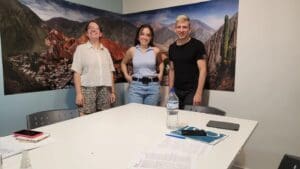
møde vores lærere i Malaga
Velkommen til Vamos Academy Malaga, din indgang til et ekstraordinært, transformerende sprogeventyr. Vi har en engagerende video af en af vores ekspertlærere, der forklarer nuancerne i spansk udtale, et perfekt eksempel på vores fordybende og interaktive undervisningsmetoder.
Vores dedikerede team af dygtige undervisere skaber personlige læringsoplevelser, der er skræddersyet til dine unikke mål og evner. I vores gruppe spansk klasser, lægger vi stor vægt på interaktiv læring inden for et støttende samfund. Ved siden af klasseundervisning uddyber vi din forbindelse til den rige andalusiske kultur gennem en række sociale og kulturelle aktiviteter.
Hvis du overvejer at tilmelde dig, tøv ikke med at nå ud. Vi er mere end glade for at give dig mere information, dele vores omfattende udtalevideo eller fortælle de utrolige oplevelser fra vores tidligere studerende. Oplev den berigende, uforglemmelige sprogrejse, der venter dig på Vamos Academy Malaga.